
History of Koh Lanta

The Two Islands
Koh Lanta district covers two main islands and more than 50 smaller ones. Lanta Noi (the smaller northern island) has farmland, government offices, and the hospital. Lanta Yai (the larger southern island) is roughly 25 km long and 3 km wide, with a mountain range running its full length and dense rainforest covering most of the interior. The west coast is where all the resorts are, with sandy beaches between rocky outcroppings. The east coast is lined with mangroves and shelters a protected basin near Old Town that provided safe year-round anchorage for trading vessels. The two main islands are connected by the Siri Lanta Bridge, opened in 2016.
The Chao Ley: First Settlers
The Chao Ley (also called Chao Nam, meaning "people of the sea") were the first to settle Koh Lanta, arriving roughly 500 years ago. They are related to the Moken, a broader group of nomadic seafaring peoples found across the Andaman coast. Historically they lived on their boats for much of the year, moving with the seasons and fishing the surrounding waters. Today, Chao Ley communities still live off the shores of Saladan and along the east coast. Their main village, Baan Sang Ka U, is on the southeast coast of Lanta Yai. Many have since been granted Thai citizenship and land titles, with fishing remaining central to community life. The Chao Ley mark the year with two important ceremonies called Loy Rua (floating boats), held on the full moon of the 6th and 11th months of the Thai lunar calendar, which usually falls around late May/early June and late October/early November. Small spirit boats are launched to carry away illness and bad fortune. These are living traditions, not tourist events.
The Thai-Muslim Community
About 300 years ago, Malay migrants began arriving from Sai Buri and Nakorn Si Thammarat in southern Thailand. They referred to themselves as Orang Lonta, from the Malay word "orang" meaning "people." Old Malay maps show the island labelled Pulau Lonta, which gives the clearest picture of where the modern name "Lanta" comes from. These settlers were Muslim, initially drawn by fishing and later moving into trade. Today the majority of Koh Lanta's permanent residents descend from this community, and two distinct Muslim sects are represented on the island. The Muslim character of the island is what makes it feel different from Phuket, Koh Samui, or Bangkok, where Buddhist culture dominates.
The Chinese Traders
Around 100 years ago, a third community arrived: Chinese merchants who fled during a period of upheaval in China, coming from Kwang Tung, Hai Lham Island, and SuaThaw. They initially traded in tin, charcoal, and dried fish, then expanded into Western goods through connections with British colonial ports. Their descendants still dominate trade on the island, and the Sino-Portuguese wooden shophouses in Old Town are the most visible legacy of their settlement.
Sri Raya: The Original Trading Port

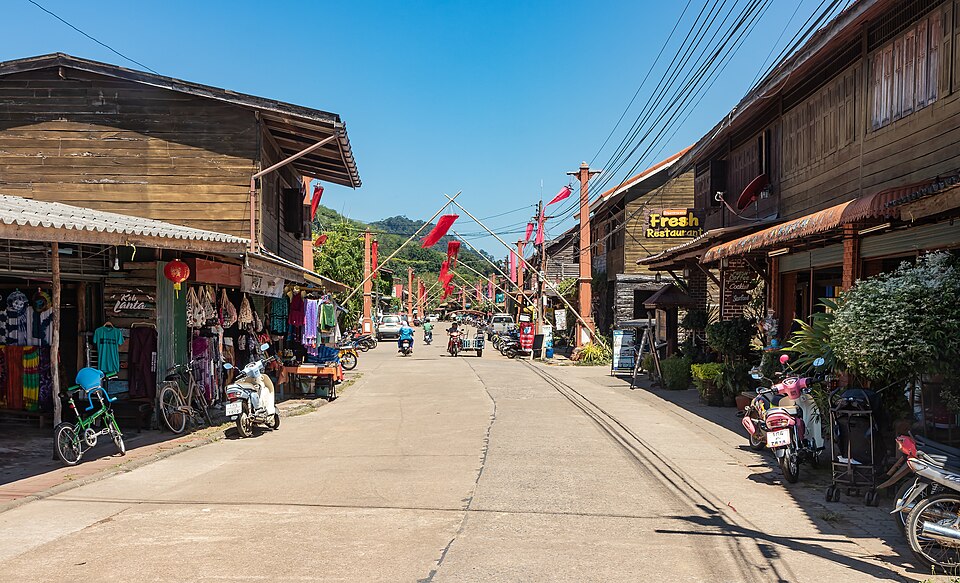
Before the road network and car ferry existed, the island's main port was Sri Raya, which is now known as Koh Lanta Old Town. Its east-coast location, sheltered in a protected basin behind the mangroves, made it a natural stopping point for Arabic and Chinese traders moving between Phuket, Penang, and Singapore. Tin, charcoal, and dried fish were the main commodities moving through the port. As roads improved and the car ferry to Saladan in the north became the main entry point, Sri Raya gradually stepped back from its role as the island's commercial centre. Saladan grew up around the ferry connection and is now the functional hub, while Old Town retained its old architecture and quiet character. The wooden shophouses and stilted homes over the water are roughly 100 years old, and a Chinese shrine in the heart of the old port district marks the traders' long presence here. Old Town is worth a half-day visit, particularly on a Sunday morning when a market runs from 8:00-11:00 AM.
National Park
Mu Ko Lanta National Park was established on August 15, 1990, covering the southern tip of Lanta Yai and surrounding smaller islands. It protects marine ecosystems, mangroves, and rainforest. Entrance fee: 200 THB for adults, 100 THB for children, plus 20 THB per scooter.
Tourism
Tourism began in the late 1980s, initially attracting backpackers who wanted something quieter than Phi Phi or Phuket. For years that low-key reputation was the main draw. Infrastructure has improved steadily: reliable electricity, paved roads, and the Siri Lanta Bridge have all brought faster development. Today Koh Lanta has accommodation across every budget, from backpacker guesthouses to five-star resorts, while still retaining a more relaxed character than the larger southern Thai islands.